
When you think of a family day out at a theme park, you usually picture bright lights and passive entertainment. Children often sit in a plastic carriage before an operator presses a button, which makes the ride go around in circles. While that is undeniably fun, Diggerland UK offers a completely different kind of experience. This park perfectly blends high-octane excitement with genuine, hands-on learning.
Behind all the bright yellow paint and roaring diesel engines lies a massive, interactive classroom. Operating genuine construction machinery offers a fantastic boost to a child’s development because it provides an ideal environment for real-world STEM education. Consequently, a trip to the park builds crucial cognitive skills. This setup allows children to engage with science, technology, engineering, and maths naturally.
Spatial Awareness and Coordination through Real-World STEM
Sitting in the cab of a mini-digger requires a surprising amount of brainpower. In fact, the activity offers a masterclass in real-world STEM mechanics. Unlike a video game controller with simple thumb movements, operating an excavator arm demands complex hand-eye coordination.
To successfully scoop up dirt or knock over a skittle, a child must manipulate two separate joysticks simultaneously. One lever controls the boom to move it up and down, whereas the other lever controls the bucket, tilting it to scoop or dump. This forces the brain to calculate spatial depth, judge distances, and understand physical movement through three-dimensional space. Ultimately, it is a fantastic, practical application of geometry and physics that traditional classrooms cannot replicate.
Problem Solving and Fine Motor Skills
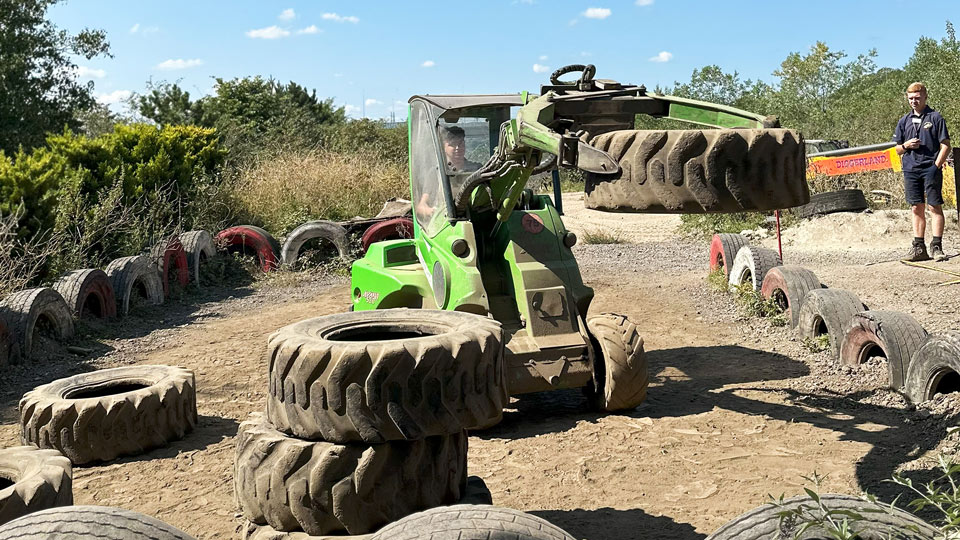
For example, rides like StackAttack provide a brilliant illustration of this cognitive challenge. Here, visitors operate an Avant loader equipped with a special attachment to stack massive, heavy tyres on top of one another. Therefore, this particular attraction takes real-world STEM problem-solving to a whole new level.
However, this task heavily rewards patience. If the child moves the controls too quickly, the tyres will wobble and fall. As a result, they must learn how to make micro-adjustments, feathering the levers to achieve smooth, precise movements. Creating a perfectly straight stack of tyres means a child actively tests hypotheses, adjusts their approach based on real-time feedback, and masters fine motor control.

Demystifying Mechanics and Hydraulics
Children naturally want to know how things work, so Diggerland provides a completely transparent look at heavy engineering. Sitting close to the machinery allows children to see exactly how power transfers from the engine to the tracks. Because of this, the layout turns abstract curriculum topics into a tangible, real-world STEM experience.
Furthermore, parents can easily point out the thick hydraulic rams expanding and contracting to lift heavy steel arms. Watching these engineering concepts operate right in front of them helps demystify mechanical science. In addition, it turns abstract physics textbook principles into memorable, real-world examples, potentially sparking a lifelong interest in civil engineering or mechanical design.
In conclusion, a day out at Diggerland proves that education does not have to be confined to a desk or digital screen. By giving children the keys to real, powerful machinery, you let them test the laws of physics. Meanwhile, they improve their spatial intelligence and build immense personal confidence. It is a brilliant, mud-splattered way to introduce real-world STEM concepts, inspiring the next generation of British engineers and scientists.
Information correct at the time of posting on 20th July 2026.